Auto H1
What is Cebra?
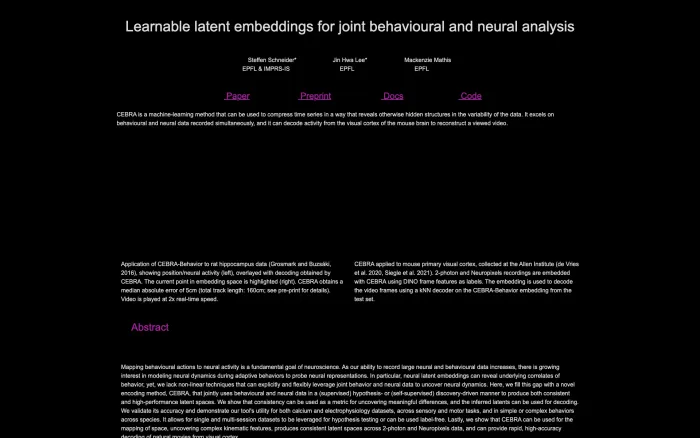
Cebra stands as an advanced machine learning application specifically designed to streamline the analysis of time series data, unearthing underlying patterns and variations that might otherwise remain obscured. It shines particularly in the realm of behavioral neuroscience, where it has demonstrated its prowess by decoding neural activity within the visual cortex of mice, enabling the reconstruction of the images they have seen.
Moreover, Cebra’s versatility extends to the examination of hippocampal data in rats, as well as data derived from 2-photon neuropixels recordings. Through these analyses, it adeptly charts spatial representations and disentangles intricate kinematic details. The platform operates by integrating behavioral and neural data within a unified framework that is both learnable and self-supervised, resulting in the generation of robust and high-fidelity latent representations.
Cebra’s effectiveness has been rigorously tested and confirmed for its precision and practicality across a variety of sensory-motor tasks, as well as both simple and complex behavioral studies spanning different species. A significant advantage of Cebra is its capacity to handle datasets from single or multiple sessions, facilitating hypothesis exploration without the necessity for manual data labeling.
For those interested in exploring Cebra further, the pre-print detailing the algorithm’s intricacies and its software implementation are both accessible, hosted on the preeminent platforms of arXiv and GitHub, respectively.
USE CASES
- Analyzing visual cortex activity in mouse brain to reconstruct viewed video
- Mapping rat hippocampus data and uncovering complex kinematic features
- Producing high-performance latent spaces for sensory motor tasks and behaviors across species
- Leveraging single and multi-session datasets for hypothesis testing without labeling
- Compressing time series data for efficient storage and analysis.